ARTICLE INDEX
April 29, 2016
Dangers lurk in equine dentistry
The use of motorized dental equipment has become quite popular and is now commonly
used by many veterinarians and equine dental technicians around the world.
The use of motorized gear began at least 60 years ago in Germany with rotary grinding wheel stones used to shape
and cut teeth. During World War II, this type of technology was lost; and as the importance of horses fell, following
the war, the art and science of equine dentistry withered to the occasional manual removal of enamel points.
Equine dentistry was not considered to be very important and received very little attention by veterinary educational
programs.
[ Read more... ]
June 19, 2014
PASO FINO DENTISTRY
My trip in November 2011 to the Mundial World Cup Paso Fino show in San Juan,
Puerto Rico, impressed upon me the excitement and passion that this breed inspires in spectators, riders, and their
trainers and owners. Pasos are truly unique - in their behavior, gaits, conformation, and even their teeth ! I
am an equine veterinary dental practitioner that is on a mission to spread the word that Paso Finos have special
denial needs.
Let's face it, it is a tough job for the horse to make it to the championship level, and they need all the help
they can get. This breed's demanding gaits require incredible concentration by the horse to maintain the steady,
continuous, rapid movements. Only horses with good equilibrium (sense of balance) can perform the tight figure-8
phase of their test properly. A horse's balance center is found in their temporal bones of the upper part of their
skull which contains the semicircular canals of the inner ears. Most people do not realize that there is another
component to the balance system. The lower jaw, or mandible, also communicates through the temporomandibular joint
(TMJ) to the balance center, and acts as a gyroscope to maintain the exquisite coordination required for optimum
performance. Normally the position and movement of the mandible is affected by gravity and head carriage to relay
messages to the brain to feedback "body-awareness" (proprioception) like a computer-controlled traction,
suspension, and braking system in a very expensive Mercedes or BMW high-performance automobile.
[ Read more... ]
Wednesday, December 17, 2008
Equine Dream Jobs: Third in the Series Equine Dentistry
Article by Bill Weisenburger
Photos Courtesy of The American School of Equine Dentistry
I remember sitting at the dinner table, doing my best to “entertain” my little
brother by chewing with my mouth open and dribbling corn down my chin. In addition to the desired squeals of laughter
from my brother, I elicited a response from Mom. Horrified, she exclaimed “Stop that! You are eating like a horse!”
Needless to say her attitude resulted in more hilarity leading to another response from Mom…and it was the early
sixties and Mom was not a hippie. Ouch!
As it turns out, mom was right. I was chewing like a horse, a horse that needed
a visit from the dentist. Horses that need some attention to their mouth exhibit a wide range of behaviors from
dropping grain while chewing to acting up while being ridden. Besides being a little annoying such behaviors can
lead to weight loss in the horse as well as being dangerous to the rider. [ Read more... ]
Thursday, December 19, 2002
Dental Outlaws?
Few veterinarians have advanced training and skill in equine dentistry; but many
of the people who DO must work outside the law.
By Diana Thompson
Many horse owners work with trusted veterinary professionals to assure their horses
receive exemplary health care. Often, they are advised to care for their horses’ teeth by having a procedure commonly
called "floating" performed by the veterinarian at least once a year. Once that task is completed, they
rest assured, thinking their horses’ teeth have received proper care.
[ Read
more... ]
Holistic Husbandry
Article from The Whole Horse Journal, February 2000
DO Look in Your Horse's Mouth
Proper dental care entails far more than simply "floating" the teeth.
ARTICLE AND ILLUSTRATIONS BY BARBARA CHASTEEN
Dana was in decline. A big, beautiful cavalry-style Morgan who once enthusiastically
traveled thousands of trail miles, he had become a grouch. His neck stayed tense no matter how much chiropractic
or massage he got. He couldn't walk straight, his back hurt, he was always a little thin. Mostly he stood in his
paddock, leaning heavily on his forehand to alleviate the pain of arthritis in his hocks, which didn't respond
to Bute and light exercise, steroid or hyaluronic acid injections, or any other therapy. At 15 years hold, in what
should have been the prime of his life, he seemed laid up for good.
[ Read
more... ]
Loudoun School Helps Revive the Practice of Equine
Dentistry
Washington Post - 09/05/99
Ed Pearson slowly pries open the mouth of his patient. He wiggles his slender
fingers past the front teeth and pushes his hand over a foot-long gray and pink tongue. With his entire forearm
stuck inside the mouth, he bends his knees and angles a small flashlight attached to the brim of his beige baseball
cap.
"There it is!" Pearson says, smiling as he rubs his fingers along the
gums. He pulls a foot-long pair of cutters from his bucket, wiggles them inside the mouth and squeezes hard, his
face turning slightly red.
Pop! Out comes a two-inch-long, blackish tooth.
Pearson's patient, though heavily sedated, stumbles backward from the sudden force.
But the discomfort is worth it. The overgrown molar was preventing Katie Jean, a 1,100-pound Belgian mare, from
grinding and swallowing all her food and had caused her to lose 500 pounds.
[ Read more... ]
The Dental Dilemma
Article from The Whole Horse Journal, September/October 1998. You may obtain a
subscription to The Whole Horse Journal by calling 1-800-829-5580.
All graphics are located on the side or top of this article (ignore the graphic
locations which the article specifies).
The Dental Dilemma
What care does your horse need, and who should provide it?
BY NADINE LAVELL / PHOTOS BY ELVIRA LAVELL
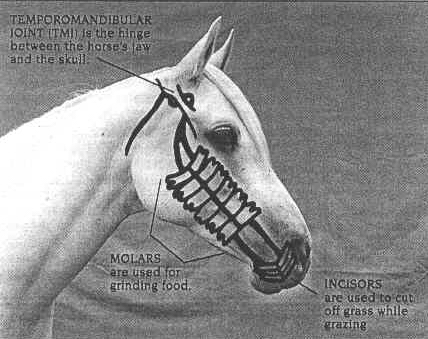
I was professionally involved in human dentistry as a clinical dental hygienist
for more than 25 years. Even though I looked in 40 to 50 human mouths per week, and had advanced education, including
a masters degree in dental hygiene, it never occurred to me that my horse had extensive dental needs as well. Like
many horse owners, I thought I was being responsible if I asked my general practice veterinarian to check my horse's
mouth once a year. The veterinarian would then "float" the teeth "if necessary" and we would
be set for another year.
[ Read
more... ]
Steer Clear of Poisonous Plants
April 1998
Published by HorsePlay
Raymond Hyde, DVM
Charles Sr. was enjoying farm-sitting for his son, who was away on vacation with
the grand kids. The elder Charles loved to work in the garden, so he decided to weed and trim his son's hedges.
Seeing that the family's horses did not have much forage in the pasture, he threw the clippings and weeds over
the fence to them. "Why let them go to waste?" he thought. The herd of 30 horses greedily consumed the
unusual offerings.
[ Read
more... ]
Equine Dentistry
March 1998
Published by HorsePlay
Raymond Hyde, DVM
Goldie was beautiful with long blonde hair, well muscled thighs and legs. She
moved real nice and had a pedigree to match. What was she doing in a place like this - a low price livestock auction?
The palomino mare was being "dumped" because she would toss her head up and down and become upset with
any bit contact, and was considered untrainable.
Mort was a beautiful and well mannered 16.3 hand, bay, Thoroughbred gelding with
a classic head and neck. He had had 3 years of foxhunting experience, but was dropped off at the hunt's kennels
to be fed to the hounds. He had become dangerous because he would rear and run backward when ridden.
[ Read
more... ]
Plan Your Vaccination Schedule Now
February 1998
Published by HorsePlay
Raymond Hyde, DVM
I had the displeasure one summer day of being called out by a new client to examine
a two-year-old Appaloosa he had recently purchased in Florida. I found her lying in a semi-comatose state caused
by Eastern equine encephalomyelitis.
[ Read
more... ]
Au Naturel Breeding Is Best for Some Stallions
January 1998
Published by HorsePlay
Raymond Hyde, DVM
After I palpated the Thoroughbred mare and determined that she was close to ovulation,
my client led her in a curiously circuitous route to the far side of the Shire stallion's pasture. We opened the
gate, turned her into the field, and retreated to safety outside the gate. The stallion's owner then called for
him. The black stallion responded with a screaming call and turned into a steaming 1,800-pound equine locomotive.
He seemed to double in size as he charged with thundering hooves to lay claim to his new mate.
[ Read more... ]
Incisor Reduction
Article from The Whole Horse Journal, July/August 1997. You may obtain a subscription
to The Whole Horse Journal by calling 1-800-829-5580.
All graphics are located here (opens in a new window) (ignore the graphic locations
which the article specifies - they are in place due to copyright laws).
Incisor Reduction
Who should perform this procedure?
As part of the process of taking care of our domestic horses' teeth, the length
and shape of the incisors must be addressed. Horse owners need to be aware, however, that their otherwise highly
trained veterinarian may not be fully qualified in this specialty area. As one source explains, a good dentist
may not happen to be a veterinarian and a good veterinarian may not be a dentist.
[ Read
more... ]
Insidious Incisors
EDUCATIONAL ARTICLES
Article from The Whole Horse Journal, July/August 1997. You may obtain a subscription
to The Whole Horse Journal by calling 1-800-829-5580.
All graphics are located here (ignore the graphic locations which the article
specifies - they were kept in place due to copyright laws).
Insidious Incisors
ARTICLE AND PHOTOS BY DIANA THOMPSON
Wild horses eat for a living. In order to take in enough grass to meet their nutritional
needs, they spend 12 to 18 hours a day in pursuit of food. While it sounds divine, their task is tedious. Several
blades of grass are nibbled into position by the horse's lips and then cut off by his front teeth. Then this relatively
small amount of food is transferred to the back teeth where it is thoroughly ground up before being swallowed and
passed into the digestive tract.
This method of feeding - labeled continuous grazing by one author - actively engages
all of the functional teeth in the horse's mouth. It is an intricate system of diet, anatomy, and lifestyle which
evolved over 20 to 40 million years.
[ Read
more... ]
|